Shrew
Small, voracious insectivores related to hedgehogs and moles.

Wikimedia Commons · CC BY 4.0
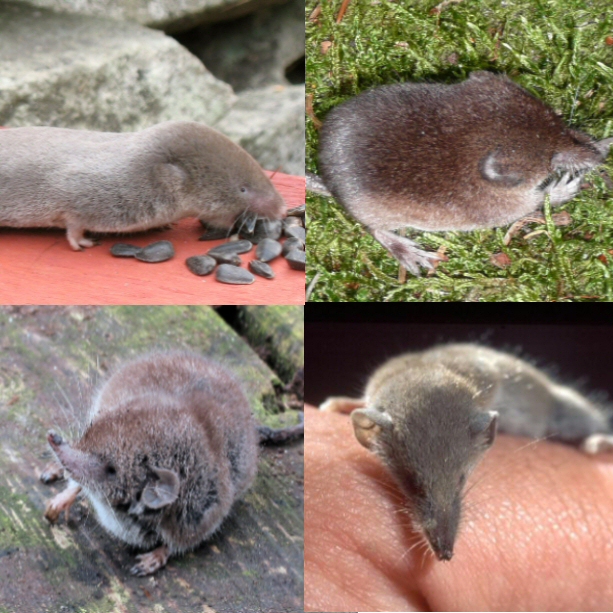
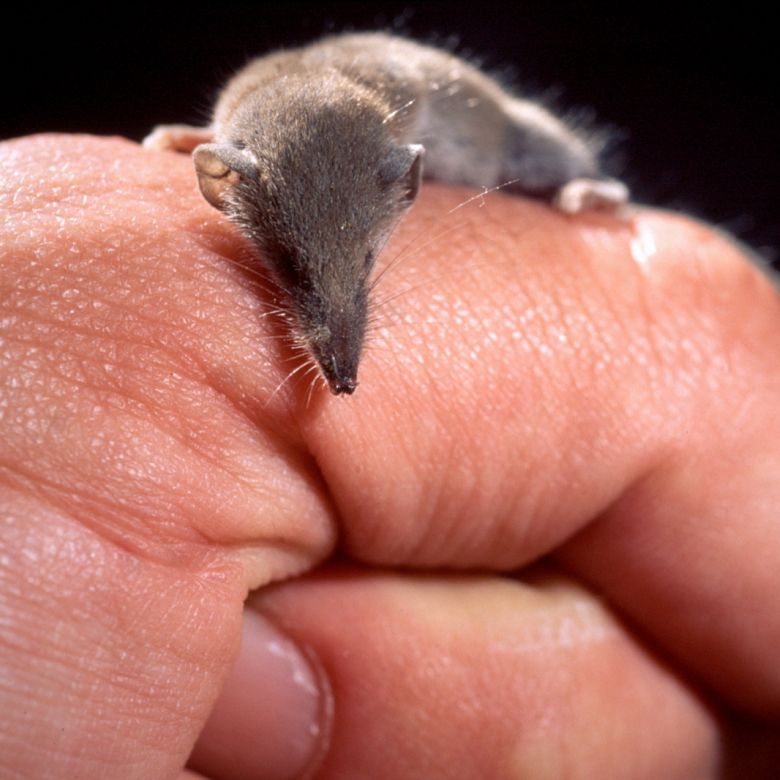
Shrews are small, mole-like mammals belonging to the family Soricidae and the order Eulipotyphla. They are not rodents, despite a superficial resemblance to long-nosed mice, but are more closely related to hedgehogs and moles. Shrews are distributed almost worldwide, absent only from New Guinea, Australia, New Zealand, and South America (except for a recently naturalized population in the northern Andes).
- classification
- Family Soricidae, order Eulipotyphla
- smallest_species
- Etruscan shrew (Suncus etruscus), about 3.5 cm long, 1.8 g
- lifespan
- 12 to 30 months
- gestation_period
- 17–32 days
- distinguishing_feature
- Sharp, spike-like teeth; some species have iron-reinforced red teeth
Lore & Background
Shrews are tiny, terrestrial creatures that forage for seeds, insects, nuts, worms, and other foods in leaf litter and dense vegetation. Some species specialize in climbing trees, living underground, under snow, or hunting in water. They have small eyes and poor vision but excellent senses of hearing and smell. Shrews are very active, with voracious appetites and unusually high metabolic rates; in captivity they can eat 1/2 to 2 times their body weight daily. They do not hibernate, but some enter torpor, and many species undergo morphological changes in winter that reduce body weight by 30–50%, shrinking bones, skull, and internal organs.
Reader's Guide
Shrews are significant for their unique biological adaptations and ecological roles. They are among the smallest terrestrial mammals, with the Etruscan shrew being the smallest known living terrestrial mammal. Their teeth wear down throughout life (they have only one set), and in some species iron reinforcement in the enamel prolongs tooth life. Shrews are also notable for being venomous: some species have grooved teeth that deliver venom containing compounds potentially useful for treating high blood pressure, neuromuscular diseases, migraines, and ovarian cancer. Additionally, some shrews use echolocation—low-amplitude, ultrasonic squeaks—for close-range spatial orientation, making them one of the few terrestrial mammal groups to do so. Their high metabolic rates and constant need to eat make them important predators of invertebrates and small vertebrates in many ecosystems.
Did You Know?
- The Etruscan shrew (Suncus etruscus) is the smallest known living terrestrial mammal, at about 3.5 cm and 1.8 grams.
- Some shrew species are venomous; the venom of the American short-tailed shrew can kill 200 mice by intravenous injection.
- Shrews can lose 30–50% of their body weight in winter, shrinking bones, skull, and internal organs.
- Female shrews can have up to 10 litters a year and often become pregnant within a day of giving birth.
Taxonomy and the Rodent Confusion
Shrews occupy a fascinating taxonomic position that has long tripped up casual observers. Though their compact, pointed-snouted bodies closely resemble those of mice, true shrews (family Soricidae) are not rodents at all. They sit within the order Eulipotyphla, making them far closer kin to hedgehogs and moles than to any member of the rodent families. The only link to rodents is the broad Boreoeutheria magnorder that groups many northern-hemisphere mammals together. This distinction is visible in the mouth: shrews carry sharp, spike-like teeth designed for gripping prey, while rodents rely on ever-growing gnawing incisors. The name "shrew" is also a source of widespread confusion, as treeshrews, otter shrews, elephant shrews, West Indies shrews, and marsupial shrews all belong to entirely different families or orders. Within the true family, 385 species are organized into 26 genera and three living subfamilies—Crocidurinae (white-toothed shrews), Myosoricinae (African shrews), and Soricinae (red-toothed shrews)—making Soricidae the fourth-most species-rich mammal family on Earth, surpassed only by two rodent families and the vesper bats.
A Metabolism That Never Rests
The metabolic engine inside a shrew is one of the most extreme in the animal kingdom. Most species are no larger than a mouse, with the Etruscan shrew tipping the scales at a mere 1.8 grams and 3.5 centimeters—the smallest known living terrestrial mammal—while the Asian house shrew stretches to roughly 15 centimeters and 100 grams. Despite their tiny frames, shrews burn energy at rates well above what comparable small mammals would be expected to sustain. The consequence is a relentless need to feed: in captivity, a shrew may consume anywhere from half to twice its own body weight in food every single day. They forage through leaf litter and dense grass for seeds, insects, worms, and nuts, and some specialize in climbing, burrowing, hunting under snow, or even catching prey in water. Their teeth, unlike those of rodents, do not regrow; they wear down over a lifetime. To compensate, many species deposit iron in the exposed enamel, giving the teeth a dark red coloration that reinforces the most stressed surfaces. This adaptation is absent in lower-metabolism relatives that simply do not grind their teeth as hard.
Venom, Sonar, and Missing Bones
Shrews possess a collection of biological oddities that set them apart from nearly every other mammal. A handful of species produce venom, delivered not through fangs but through grooves worn into their teeth. The venom of the American short-tailed shrew is potent enough that its gland contents could kill two hundred mice if injected intravenously. Compounds from shrew venom show promise in treating high blood pressure, certain neuromuscular disorders, and migraines, while soricidin, a peptide in the saliva of the northern short-tailed shrew, has been investigated as a potential therapy for ovarian cancer. In sensory biology, two shrew genera—Sorex and Blarina—are among the very few terrestrial mammals known to echolocate. They emit ultrasonic squeaks that are low-amplitude, broadband, and frequency-modulated, quite unlike the sharp clicks of bats. Rather than pinpointing individual prey, these shrews appear to use the overall reverberation of their calls to gauge habitat type, much as a human might distinguish a beech forest from a wine cellar by the echo of a shouted call. Anatomically, shrews also lack zygomatic bones entirely, leaving their facial arches incomplete—a trait shared with very few other mammals.
Rapid Reproduction and Winter Survival
Shrews lead lives of extraordinary reproductive intensity. In tropical regions, females can produce up to ten litters per year, breeding continuously throughout the seasons. In temperate zones, they pause only during winter. Gestation is remarkably brief, lasting just 17 to 32 days, and a female can become pregnant again within a day of giving birth, even lactating for the new litter while still nursing the previous one. Lifespans are short, typically 12 to 30 months. A striking behavior called "caravanning" is observed in many species: a litter of young forms a single-file line behind the mother, each pup gripping the fur at the base of the tail of the shrew ahead. Beyond reproduction, shrews face the seasonal challenge of winter without the option of true hibernation. Some species can enter torpor, but many instead undergo dramatic morphological changes, shedding between 30 and 50 percent of their body weight by shrinking their bones, skull, and internal organs. They are fiercely territorial, driving off rivals and gathering only to mate, and many dig burrows to catch food and shelter from predators. Despite their tiny eyes and generally poor vision, they compensate with excellent hearing and smell.
Gallery

Frequently Asked Questions
Are shrews actually rodents?
No. Despite their mouse-like snouts, shrews belong to the order Eulipotyphla (family Soricidae) and are far more closely related to moles and hedgehogs than to any true rodent.
What is the smallest shrew species?
The Etruscan shrew (Suncus etruscus) is the tiniest, at roughly 3.5 cm in body length and about 1.8 g in weight. It is one of the smallest placental mammals known.
How long do shrews typically live?
Most shrew species survive only 12 to 30 months, a remarkably short span for a mammal. Their extremely high metabolic rate and constant need to eat drive this brief lifespan.
What physical trait sets shrews apart from similar small mammals?
Shrews have sharp, spike-like teeth rather than the flat gnawing incisors of rodents, and some species even carry iron-reinforced red teeth—a feature unique to the group.
Where are shrews NOT found in the wild?
Shrews are absent from New Guinea, Australia, New Zealand, and nearly all of South America. The sole South American exception is a recently naturalized population in the northern Andes.
More in Rodents And Small Mammals 1-18
Spotted an error? Know more?
This is a living reference — every entry is fact-audited, and reader corrections feed straight into our audit queue. Suggest an edit · See this site's audit record