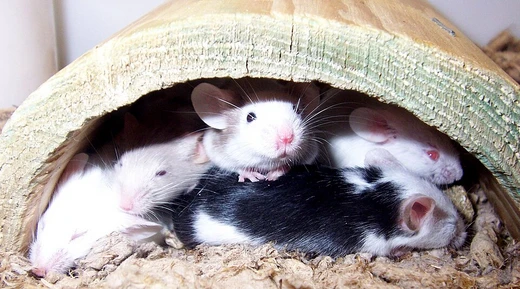
Gerbillinae
Rodent subfamily adapted to arid habitats across Africa, India, and Asia.

Gerbillinae is a subfamily within the rodent family Muridae, grouping together gerbils, jirds, and sand rats. These animals, formerly called desert rats, include roughly 110 species native to Africa, India, and Asia, all suited to dry environments. While most are active at dawn and dusk or during the night—making them crepuscular or nocturnal—a few, such as the common pet species, are also active during the day. Nearly all are primarily herbivorous, feeding on seeds, grains, and plants, with only occasional insect consumption. The name "gerbil" is a smaller form of "jerboa," a different group of rodents that fills a similar ecological role. An average adult gerbil weighs around 70 grams (2.5 ounces). One species, the Mongolian gerbil (*Meriones unguiculatus*), also called the clawed jird, is gentle and resilient, making it a popular pet. It is also used in scientific research.
**Classification**
SUBFAMILY GERBILLINAE
Genus *Ammodillus* Ammodile, *Ammodillus imbellis*
Tribe Desmodilliscini Genus *Desmodilliscus* Pouched gerbil, *Desmodilliscus braueri* Genus *Pachyuromys* Fat-tailed gerbil, *Pachyuromys duprasi*
Tribe Gerbillini Subtribe Gerbillina Genus *Dipodillus* Botta's gerbil, *Dipodillus bottai* North African gerbil, *Dipodillus campestris* Wagner's gerbil, *Dipodillus dasyurus* Harwood's gerbil, *Dipodillus harwoodi* James's gerbil, *Dipodillus jamesi* Lowe's gerbil, *Dipodillus lowei* Mackilligin's gerbil, *Dipodillus mackilligini* Greater short-tailed gerbil, *Dipodillus maghrebi* Rupicolous gerbil, *Dipodillus rupicola* Lesser short-tailed gerbil, *Dipodillus simoni* Somalian gerbil, *Dipodillus somalicus* Khartoum gerbil, *Dipodillus stigmonyx* Kerkennah Islands gerbil, *Dipodillus zakariai* Genus *Gerbillus* Subgenus *Hendecapleura* Pleasant gerbil, *Gerbillus amoenus* Brockman's gerbil, *Gerbillus brockmani* Black-tufted gerbil, *Gerbillus famulus* Algerian gerbil, *Gerbillus garamantis* Grobben's gerbil, *Gerbillus grobbeni* Pygmy gerbil, *Gerbillus henleyi* Mauritanian gerbil, *Gerbillus mauritaniae* (sometimes considered a separate genus *Monodia*) Harrison's gerbil, *Ge
- classification
- Subfamily of Muridae
- common_names
- Gerbils, jirds, sand rats
- species_count
- About 110
- average_weight
- About 70 grams (2.5 oz)
- notable_species
- Mongolian gerbil (Meriones unguiculatus), popular pet and research animal
Lore & Background
The gerbil got its name as a diminutive form of 'jerboa', an unrelated group of rodents occupying a similar ecological niche. The average adult gerbil weighs about 70 grams.
Reader's Guide
The subfamily Gerbillinae includes a diverse array of species classified into multiple tribes and genera, such as Ammodillus, Desmodilliscus, Pachyuromys, Dipodillus, Gerbillus, Meriones, Psammomys, Rhombomys, and others. One species, the Mongolian gerbil (Meriones unguiculatus), also known as the clawed jird, is a gentle and hardy animal that has become a popular small house pet and is also used in some scientific research. The subfamily's significance lies in its adaptation to arid environments and its role as both a model organism in research and a common companion animal.
Did You Know?
- The gerbil's name is a diminutive form of 'jerboa', an unrelated rodent group.
- Most gerbils are crepuscular or nocturnal, not diurnal, though a few species may be active during the day.
Taxonomic Breadth and Classification
Gerbillinae stands as one of the subfamilies nested within the rodent family Muridae, encompassing a remarkable array of small mammals collectively recognized as gerbils, jirds, and sand rats. The subfamily is home to roughly 110 distinct species distributed across Africa, India, and Asia, all sharing a fundamental adaptation to arid environments. Its taxonomic architecture is impressively layered: the group is divided into several tribes, including Desmodilliscini, Gerbillini, Gerbillurini, and Taterillini, each containing multiple genera. The tribe Gerbillini alone houses subtribes such as Gerbillina and Rhombomyina, which in turn shelter genera like Dipodillus, Gerbillus, Brachiones, Meriones, Psammomys, and Rhombomys. Within Gerbillus, two subgenera—Hendecapleura and Gerbillus—further subdivide the species, while Meriones is split into four subgenera: Meriones, Parameriones, Pallasiomys, and Cheliones. Additional genera such as Ammodillus, Desmodilliscus, Pachyuromys, Microdillus, Sekeetamys, Desmodillus, Gerbilliscus, Gerbillurus, Tatera, and Taterillus round out the full roster, making Gerbillinae one of the most species-rich and structurally complex subfamilies in the Muridae.
Body Form and Arid Adaptation
Members of Gerbillinae were historically referred to as desert rats, a label that captures their defining ecological niche: life in dry, arid landscapes spanning the African, Indian, and Asian continents. In terms of body proportions, a typical gerbil measures between 150 and 300 millimeters from nose to tail tip, with the tail alone accounting for roughly half of that total length. The average adult tips the scale at approximately 70 grams, a weight that reflects their compact, lightly built frame suited for rapid movement across open ground. At the upper extreme of size, the great gerbil (Rhombomys opimus), a species originally native to Turkmenistan, can exceed 400 millimeters in overall length, making it a true outlier among its relatives. Despite this range in absolute size, the subfamily shares a coherent body plan shaped by the demands of arid survival: a long tail for balance and thermoregulation, a relatively short body, and a build that minimizes water loss. These morphological traits, combined with their geographic concentration in deserts and semi-deserts, underscore why every member of this group is fundamentally a creature of dry habitats.
Activity Patterns and Feeding Ecology
A striking feature of Gerbillinae is the consistency of its behavioral and dietary profile across the roughly 110 species it contains. The vast majority of gerbils, jirds, and sand rats are diurnal, meaning they conduct most of their foraging, social, and territorial activities in broad daylight. This daytime activity pattern is well suited to the open, arid environments they inhabit, where the heat of the day drives them to exploit cooler morning and late-afternoon windows. However, not every species follows this rule; a subset, including the well-known Mongolian gerbil kept as a household pet, displays crepuscular behavior, shifting its peak activity to the twilight hours of dawn and dusk. On the dietary front, the subfamily is remarkably uniform: nearly all members are omnivorous, supplementing plant material with insects and other small animal matter. This flexible feeding strategy is an important adaptation to the patchy resource availability of desert and semi-desert ecosystems. Interestingly, the very name "gerbil" is a diminutive of "jerboa," an entirely unrelated rodent group that occupies a comparable ecological niche, hinting at how convergent selection shapes small mammals in arid zones.
The Mongolian Gerbil: From Steppe to Home and Laboratory
Among the many species catalogued under Gerbillinae, none has achieved a more prominent place in human culture than the Mongolian gerbil, Meriones unguiculatus, also widely called the clawed jird. Classified within the subgenus Pallasiomys of the genus Meriones, this particular species has distinguished itself through two roles that extend far beyond its native steppe habitat. First, its temperament—described as gentle and hardy—has made it a beloved small house pet, prized for its manageable size and docile nature. Second, its biological robustness and ease of breeding in captivity have rendered it a valuable subject in scientific research, where it serves as a model organism in comparative medicine and laboratory studies. Notably, the Mongolian gerbil departs from the diurnal norm that characterizes most of its subfamily, exhibiting crepuscular activity instead, a trait that makes evening interaction with a pet particularly natural. Its presence in both domestic living rooms and research laboratories illustrates how a single species within a taxonomically diverse subfamily can bridge the gap between wild ecology and everyday human life.
Frequently Asked Questions
Who is Gerbillinae?
Gerbillinae is a subfamily within the rodent family Muridae that bundles together gerbils, jirds, and sand rats into a single group. It encompasses roughly 110 species native to the arid regions of Africa, India, and Asia.
What are Gerbillinae's powers/role?
These rodents are specialists of dry, sandy habitats, with most species timing their activity to dawn, dusk, or night to dodge the midday heat. Their diet is almost entirely plant-based, built around seeds, grains, and vegetation, with only the occasional insect snack.
How does Gerbillinae's story end?
As a living subfamily, Gerbillinae has no single finale—its roughly 110 species continue to thrive across deserts and semi-arid zones today. The Mongolian gerbil, the group's most famous member, also carries on a long-running second act as a staple research animal in laboratories worldwide.
Why is Gerbillinae important?
Beyond serving as seed-eaters and prey in arid ecosystems, the subfamily gives us the Mongolian gerbil (Meriones unguiculatus), one of the most popular small-mammal pets and a standard biomedical model. The very name 'gerbil' is actually a shrunken form of 'jerboa,' a completely separate rodent group.
How big and heavy is a typical Gerbillinae?
The average member of this subfamily tips the scale at around 70 grams (roughly 2.5 ounces), keeping them small and nimble in sandy, rocky terrain. A handful of species, including the common pet gerbil, are active during daylight hours rather than following the crepuscular or nocturnal pattern most of the group prefers.
More in Rodents And Small Mammals 1-18
Spotted an error? Know more?
This is a living reference — every entry is fact-audited, and reader corrections feed straight into our audit queue. Suggest an edit · See this site's audit record